ICEBAT 2026 Conference Presentations
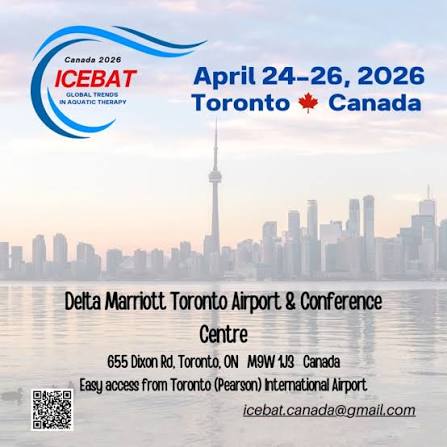
This collection brings together 14 presentations from the 7th International Conference on Evidence Based Aquatic Therapy (ICEBAT 2026), held in Toronto, Canada. Featuring internationally recognised researchers, clinicians and educators, these presentations explore the latest scientific evidence and clinical innovations in aquatic therapy, covering neurology, orthopaedics, paediatrics, chronic pain, sports rehabilitation, exercise physiology, clinical reasoning and evidence-based practice. Together, they provide a comprehensive overview of the current state of aquatic rehabilitation and its future direction.
Included presentations
- Pulling Lifestyle Diseases into the Pool – Eugenia Hernández Ruiz
Demonstrates how aquatic therapy can serve as a multisystem intervention for lifestyle-related conditions such as obesity, diabetes, chronic pain and metabolic syndrome, integrating exercise physiology with behavioural health.
Key theme: Aquatic therapy as a clinical gateway to lifestyle medicine.
- Immersion in Evidence-Based Practice: Physiological Insights for Optimizing Aquatic Exercise Dosage in Health Promotion – Cristine Lima Alberton
Explains the physiological responses to water immersion and provides evidence-based guidance for prescribing safe and effective aquatic exercise intensity using the FITT principle, heart rate and perceived exertion.
Key theme: Optimising aquatic exercise dosage.
- Splashing Through the F-Words for Child Development – Andrea Cross
Explores how aquatic therapy supports children with developmental disabilities by applying the F-Words framework to improve participation, function and family-centred care.
Key theme: Holistic paediatric aquatic rehabilitation.
- Rhythm and Music as Therapeutic Tools – Emily Dunlap
Examines how rhythm and music enhance motor learning, coordination and exercise intensity during aquatic rehabilitation through evidence-based neurophysiological principles.
Key theme: Using rhythm to optimise movement.
- Treading Water: Aquatic Treadmill Exercise for Brain Vascular Health – Professor Sam Lucas
Presents the emerging evidence showing how aquatic treadmill exercise can improve cerebrovascular health, cognitive function and brain perfusion through targeted vascular conditioning.
Key theme: Brain health through aquatic exercise.
- Getting the Dosage Right – Graded Exercise Testing – Dr Jens Bansi
Discusses graded exercise testing and cardiopulmonary assessment to accurately prescribe aquatic exercise intensity, particularly for neurological rehabilitation.
Key theme: Individualised exercise prescription.
- Beyond the Abstract – Emily Dunlap
Teaches clinicians how to critically appraise scientific literature, identify bias and interpret research quality to strengthen evidence-based aquatic therapy practice.
Key theme: From research to clinical decision-making.
- Balancing in Motion: Aquatic Reactive Balance Training – Anna Ogonowska-Slodownik
Introduces AquaReBal, an innovative approach using reactive balance perturbations in water to improve postural control and reduce fall risk.
Key theme: Fall prevention through reactive balance training.
- Surfing Clinical Reasoning in Aquatic Therapy in ASD – Javier Güeita-Rodríguez
Presents a five-stage clinical reasoning framework that connects evidence, aquatic mechanisms and participation outcomes for individuals with Autism Spectrum Disorder.
Key theme: Clinical reasoning for aquatic ASD interventions.
- Aquatic Therapy for Cerebral Palsy Recovery – Caio Roberto Ap. de Paschoal Castro
Reviews rehabilitation strategies following orthopaedic surgery and neuromuscular interventions in children with cerebral palsy, integrating ICF principles and functional aquatic therapy.
Key theme: Post-operative paediatric rehabilitation.
- Sleeping With The Enemy – Professor Jason Ellis
Explains the physiology of sleep, its relationship with rehabilitation outcomes and why improving sleep quality is fundamental for recovery and long-term health.
Key theme: Sleep as a cornerstone of rehabilitation.
- Implementing Evidence-Based Strategies for Shoulder Recovery in Swimmers – Michael Murray
Covers assessment, rehabilitation progression and return-to-sport strategies for swimming-related shoulder injuries using both aquatic and land-based interventions.
Key theme: Evidence-based shoulder rehabilitation.
- Chronic Pain: Where to Start? – Oliver Krouwel
Explores modern pain science and explains how aquatic therapy helps overcome barriers such as pain sensitisation, fear of movement and reduced physical capacity.
Key theme: Managing chronic pain through aquatic rehabilitation.
- Getting the Dosage Right – Practical Application – Dr Jens Bansi
A practical follow-up session demonstrating how graded exercise testing, heart rate, VO₂ and perceived exertion can be translated into personalised aquatic training programmes.
Key theme: Practical implementation of exercise dosing.
